The Caberlotto family founded their footwear enterprise in Montebelluna in 1939. In June 1973, following the sale of the Caber ski-boot brand to Spalding, the Caberlotto brothers launched Lotto as a dedicated sports-footwear label. Lotto’s first products were tennis shoes, soon followed by models for basketball, volleyball, athletics and football, with apparel arriving shortly after.
Montebelluna matters because it is a specialist industrial district for sports footwear. Brands across the industry have celebrated the craft base that developed there, and Lotto’s registered corporate address remains close by, at Via Montebelluna 5 to 7 in Trevignano near Treviso. This location anchors the company in the area that has supplied skilled shoemaking for decades.
Through the late 1970s and 1980s, Lotto expanded beyond tennis into football. Players and clubs helped shape product development, and the brand increased its international distribution. By the early 1990s Lotto appeared on major club and national team shirts and boots, and the double diamond became a familiar mark on European pitches. That trajectory is consistent with the brand’s own historical record and with independent retrospectives that outline Montebelluna’s role in European bootmaking.
Breaking onto the biggest stages
By the end of the 1980s Lotto had taken a deliberate step from courts to pitches. The brand first built credibility through boots worn in Serie A, then secured the kind of shirt deals that put its double-diamond where the cameras could see it.
AC Milan, 1993–1998
The Rossoneri of Capello’s era, serial Scudetto winners, European champions, and global television magnets, spent a core five-year run in Lotto. Those shirts travelled everywhere the club did: Serie A, the Champions League, the Supercoppa. It anchored Lotto’s visibility well beyond Italy.
The Netherlands, USA 1994 and Euro 1996
Oranje’s mid-90s kits were Lotto’s calling card at international level, a period that fixed the brand in the memories of a generation who watched the World Cup from America’s packed stadiums and then the Euros in England two summers later.
Croatia, France 1998
Croatia’s first World Cup was a phenomenon—new flag, new federation, and a run to the semi-final. The checkerboard slanted diagonally on a Lotto template that became instantly recognisable as Davor Šuker finished top scorer. For many collectors, that is the definitive Lotto international shirt.
Juventus, 2000–2003
Moving into the 2000s, Lotto returned to centre stage with Juventus. Those were the Fastweb years, with Del Piero, Trezeguet and Nedvěd carrying the badge. Juve in Lotto meant relentless broadcast time across Serie A and Europe.
Lotto were also a steady presence across other Italian clubs, including Fiorentina, Udinese, Bari, Genoa, Chievo and Torino, cycling in and out as supplier through the 1990s and 2000s. Abroad, the brand turned up with Real Zaragoza and others in Spain, and later in Eastern Europe where it supplied emerging national sides such as Ukraine and Serbia and Montenegro in the mid-2000s. The message was consistent: a strong Italian base and tactical expansion wherever a partnership could carry the double-diamond onto prime-time pitches.
Players in Lotto boots
Endorsements mattered long before social media did, and Lotto kept a deep roster of Serie A and international professionals in its footwear. In the mid to late 1990s, forwards and playmakers in Italy, the positions that draw the camera, were frequent Lotto wearers.
- Andriy Shevchenko wore Lotto at points early in his European rise before his long Nike association, giving the brand valuable visibility at Dynamo Kyiv and in the early Milan years
- A succession of Azzurri internationals cycled through Lotto boots in domestic play; the brand’s fit and last were popular with Italian pros who came up through Montebelluna-connected boot rooms.
- In the 2000s, Lotto backed Luca Toni during his surge to the European Golden Shoe, and sponsored a spread of Serie A strikers and full-backs whose weekly minutes kept the boots on screen even when the shirt deals rotated.
- Lotto’s player work was rarely about one global megastar; it was a network approach—seed bootrooms, look after pros in key leagues, and let the match footage carry the product week after week.
Innovation that actually changed how boots looked
Two Lotto lines, in particular, deserve their place in boot history.
Stadio
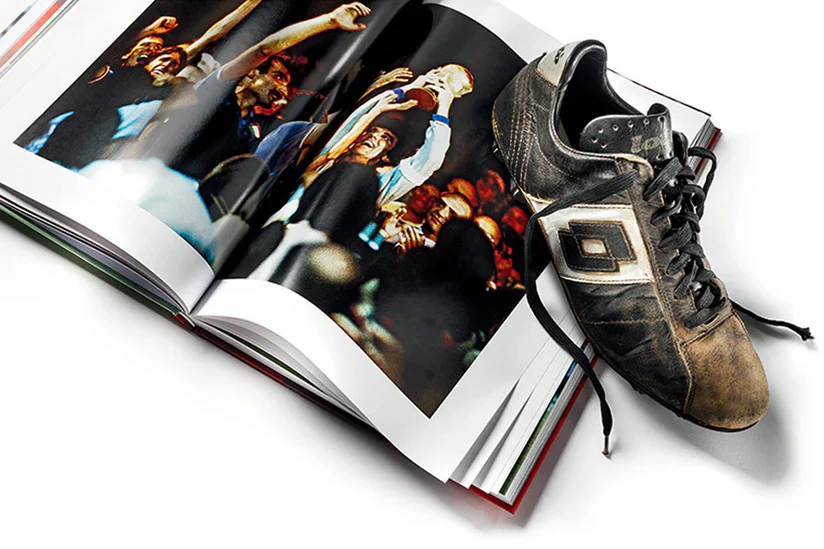
A classic leather silo that sat comfortably beside the great black-and-white boots of the 1990s. The Stadio’s reputation was simple: supple leather, reliable last, pro-room trust. If you played in Italy, you knew someone who swore by them.
Zhero Gravity (2006)
The world’s first commercially available laceless football boot. The Zhero Gravity pre-dated the modern knit, collar and vacuum-fit revolution by years. Elasticised, tensioned construction pulled the upper tight across the midfoot and struck clean without laces. For a time it was the most futuristic thing on a pitch and proved Lotto could still surprise a market dominated by bigger budgets.
Beyond those icons, Lotto iterated through technologies that became house codes: soft K-leathers and calf leathers on heritage lines; lightweight synthetic microfibres on speed boots; and outsole plates tuned to Italian pitch conditions. The brand’s tooling often had a slightly different feel to German and American rivals, reflecting Montebelluna’s craft lineage.
What changed
A major inflection point came in June 1999, when a group of local investors led by Andrea Tomat took over and renamed the company Lotto Sport Italia. Under Tomat, the business refocused on football and tennis, outsourced most production to Asia, established a logistics hub in Hong Kong, and stepped up product R&D.
The ownership structure changed again on 18 August 2021, when WHP Global acquired the global Lotto trademarks and entered a long-term partnership with Lotto Sport Italia. The agreement kept Lotto Sport Italia operating the brand in Italy, Europe, the Middle East and Africa, while WHP expanded Lotto globally through licensing.
Licensing has since advanced in key growth markets. On 19 April 2024, Reuters reported that Agilitas Sports had obtained exclusive rights to design, manufacture and distribute Lotto products in India and Australia, with a roadmap to South Africa and product launches scheduled from early 2025.
Why Lotto still matters
If you collect shirts or care about the history of boots, Lotto is one of the through-lines that connect the analogue 1980s to the modern, licensed, social-media era. That is Lotto’s real story in football: decades of visibility earned through smart placements, a boot portfolio pros trusted, and just enough audacity to shake the market when it felt safe.
The service model looks coherent. A central store simplifies consumer access, while UK teamwear and India and Australia licensing broaden reach at lower fixed cost. On-pitch visibility continues through selected club deals. In Italy, AC Monza and Lotto unveiled their 2024–25 kits on 8 August 2024, and the relationship continues into 2025–26. In England, AFC Wimbledon announced a new three-year technical partnership with Lotto on 14 April 2025, unveiling the first set of kits on 27 June 2025. The next phase would likely be selective additions to the European club roster to lift broadcast visibility.